Hey everyone, if you’ve ever hopped on a urban commute, a neighborhood run, or a quick airport transfer, you’ve probably spotted a 3-wheel electric passenger tricycle zipping by—they’re everywhere lately, and for good reason. As someone who’s worked in the electric passenger tricycle supply game for years, I get tons of questions: “How fast can these things actually go? Is that fast enough for my daily use?” It’s not a one-size-fits-all answer, but let’s break it down like we’re chatting over coffee, no jargon, just straight-up facts.
First off, let’s get the basics out of the way. A lot of folks mix up speed limits for these trikes, depending on where you’re using ’em—urban streets have different rules than closed campuses, right? As a supplier, I’ve seen people come in looking for a model for city taxi runs, others for hotel shuttles, and some for small business deliveries with passengers, so speed needs shift with use. The maximum speed isn’t just a number on a spec sheet; it’s tied to things like motor size, battery capacity, weight of the passengers and cargo, and even local regulations, which we’ll touch on later.
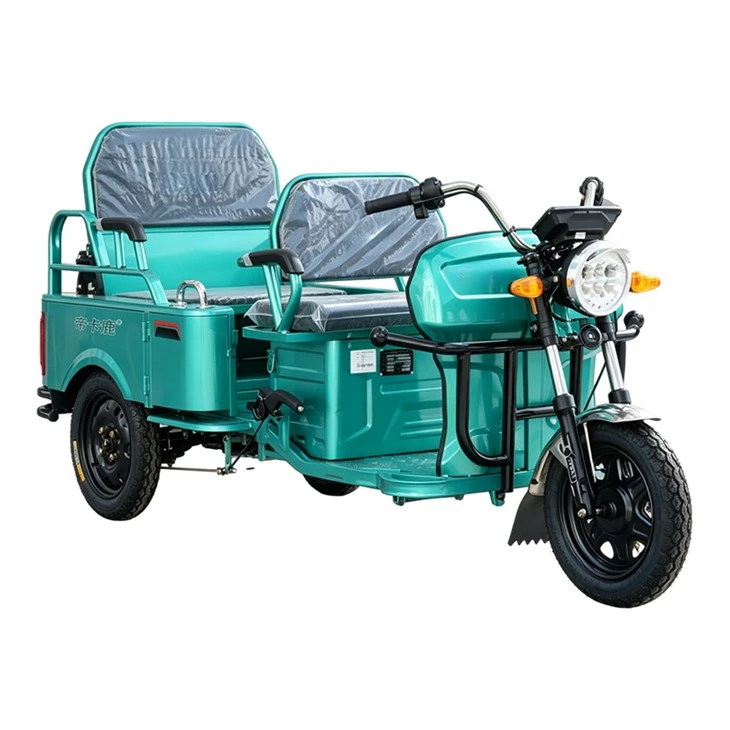
Let’s start with the core specs. Most entry-level Passenger Trike Electric models (that’s exactly what we’ve got over at our shop) use a motor in the 500W to 1000W range. Yeah, that might sound low compared to a car, but remember—these are trikes, not speed demons, built for stability and carrying people, not drag racing. The 500W variants are usually the ones for shorter, inner-city routes, maxing out around 15 to 18 mph (that’s ~24 to 29 km/h). Why? Because in a lot of cities, that’s the legal limit for low-speed electric vehicles (LSEVs) on bike lanes and quiet residential streets. If you’re planning to use it for daily commutes where you need to keep up with casual traffic, 15 mph is totally fine—no need to be zooming past buses or delivery vans here.
But if you need a bit more oomph? Our 1000W 3 Wheeler Electric Passenger Tricycle hits a higher sweet spot, typically around 20 to 25 mph (32 to 40 km/h). That’s the sweet spot for small commercial uses—like hotel shuttles moving guests between terminals or parking lots, or urban taxi trikes that need to keep pace with regular city traffic. A lot of first-time buyers are surprised to hear how much that extra motor helps, especially on small hills. If you’ve got two or three passengers plus a little extra luggage, that 1000W motor doesn’t bog down, unlike a weaker 500W model that might slow to a crawl going up a gentle slope with people on board.
Wait, let’s talk about factors that mess with that “max speed” number. It’s not just the motor, promise. First, total weight is huge. If a trike is carrying 400 lbs of passengers (say, three adults, which is standard for many passenger trikes) vs. just the driver alone, that extra weight will shave off a mph or two. Our engineering team tests every Passenger Tricycle we ship with a full load, not just empty, so the specs you see on our pages are realistic, not lab conditions. Then there’s the battery: a older, worn battery might not output as much power, so you might lose a little speed over time if you skip routine maintenance. Pro tip here: don’t leave your battery sitting dead for weeks—top it off every few days, and you’ll keep that speed consistent.
Also, terrain matters. If you’re running on flat, smooth urban pavement, you’ll hit that max speed no problem. But if you’re in a hilly area? That 25 mph top speed drops to maybe 22 mph going up a moderate hill, and you’ll notice it more if you’re carrying people. We’ve had customers in hilly neighborhoods tell us the 1000W model is non-negotiable for them, because the 500W one just couldn’t keep up when they had passengers going up to their apartment complex or local shops.

Now, let’s get into the regulatory stuff, because this is a big one that most people don’t think about. Not every place lets you run a trike at 25 mph. In the US, for example, LSEVs (which most low-power trikes fall under) are usually limited to 20 mph max on public roads. Some states classify anything over that as a “low-speed vehicle,” which requires a license and registration—something a lot of casual users don’t want to deal with. As a supplier, we always make sure to share the local rules our customers need to know, because selling a trike that’s too fast for their area is a waste of their time and money. For our international customers, it’s similar—EU countries, for example, have limits on electric two/three-wheelers for road use, so we adjust the motor and speed settings to meet local laws when needed.
Wait, let’s compare this to other options out there to put it in perspective. A standard bicycle tops out around 20 mph for an experienced rider, right? A scooter might go 25 to 30 mph, but it’s way less stable with passengers. Our trikes? They’re three-wheeled, so no balancing needed for the driver, and most models can carry two to four passengers, which is way more than a scooter can handle. So that 20 to 25 mph speed is perfect—you’re faster than a bike, more stable than a scooter, and legal for most low-traffic areas. A lot of our customers tell us that’s exactly why they chose a trike over other options: speed that’s enough for their needs, no extra hassle.
I should also mention that some custom builds can go even faster—if a customer is using it for closed campuses, like a college or a resort where there are no public road rules, we can bump the motor up to 1500W, which can hit 30 mph (48 km/h). But that’s a special order, not our standard models, so it’s good to note that your use case determines the max speed you’ll get. Most of our regular customers don’t need that—they’re using the trike for public streets where speed limits cap it anyway, so sticking to 15 to 25 mph is just right.
Another thing that affects real-world speed vs. the manufacturer’s claimed max? Aerodynamics, surprisingly. Wait, trikes aren’t sports cars, but if you’re wearing a big bulky jacket or have a passenger sitting awkwardly, that creates a little drag. Our design team optimized our Passenger Trike Electric models to have a low, streamlined frame that cuts through air resistance, so you get as close to the claimed max speed as possible. We’ve tested one of our 1000W models fully loaded with three adults, and on flat ground, it hit 24 mph—super close to the 25 mph spec, which is way better than some budget brands that list 25 mph but only hit 20 in real life.
Now, let’s talk about why speed isn’t the only thing that matters. A lot of first-time buyers fixate on max speed, but stability and range are way more important for passenger trikes. If your trike is too fast and wobbly, it’s not safe for passengers. Our 3 Wheeler Electric Passenger Tricycle models have a wide wheelbase, so they’re rock solid even at 25 mph, no leaning like a two-wheeler. And range—you could have a trike that goes 30 mph, but if it only lasts 10 miles on a charge, that’s useless for a taxi that needs to run all day. Our trikes have a 30 to 50 mile range on a single charge, depending on speed and load, so you don’t have to worry about running out of juice mid-shift.
Let’s wrap this up so it’s not a giant wall of text. To answer the question: the maximum speed of a 3-wheel electric passenger tricycle depends on motor power, load, terrain, and local rules. Entry-level models (500W) max out at 15-18 mph, great for casual use. Mid-range commercial models (1000W) hit 20-25 mph, perfect for taxi and shuttle use. Custom campus models can go up to 30 mph, but that’s not for public roads.
If you’re in the market for one, don’t just chase the highest speed—think about what you’re using it for. Are you commuting alone or with a passenger? Running a small business and need to keep up with traffic? We’ve got models for every need, and we’re happy to walk you through what works for your location and use case. If you’re ready to browse our options, check out our Passenger Trike Electric page here, our 3 Wheeler Electric Passenger Tricycle collection here, or our full line of Passenger Tricycles right here.
We work with all kinds of customers—small business owners, city transit departments, hotel managers, even schools looking for eco-friendly campus shuttles. If you’ve got specific questions about speed, load capacity, or which model fits your needs, hit us up for a procurement chat. We don’t do hard sales pitches—we just give you the straight facts so you get the right trike for your money.
References:
- U.S. Department of Energy. (2023). Light-Duty Electric Vehicle Speed and Performance Guidelines.
- European Automobile Manufacturers Association. (2022). Three-Wheeled Electric Passenger Vehicle Regulations for Urban Use.
- Our Engineering Team, Internal Testing Data. (2024). Real-World Performance of 500W/1000W Electric Passenger Trikes Under Load.